Wednesday, April 27, 2011

Four planets will be visible to naked eye at dawn


Four of the solar system's five bright planets will put on a spectacular display in the morning sky over the next month.

Those hooked to the celestial bodies will have a rare opportunity to watch Mercury, Venus, Mars and Jupiter and together in a bunch every day at dawn from April 30 to May 9.

According to Arvind Paranipye, in-charge of the public outreach programme of the Inter-university Centre for Astronomy and Astrophysics (IUCAA), "On April 30 and May 1, the four planets are joined by the earth's moon with its crescent phase."

Paranjpye further said, "The famous astronomer, Copernicus, first proposed mathematically that the planets go round the sun. It is said that he never himself set his eyes upon Mercury. But, here is a chance to see Mersury with naked eyes".

Mercury, Venus, Mars and Jupiter will be visible in the eastern sky for up to two hours before sunrise, given clear weather, until late May.

Canterbury Astronomical Society spokesman Martin Unwin said the show could be seen with the naked eye, although binoculars would help to distinguish Mars' red surface.

The planets' relative positions would change noticeably every night because each was following its own orbit around the sun.

"On several occasions during this period, two of the four planets briefly close up to lie within half a degree of each other – equal to the diameter of the moon," he said.

"Jupiter and Mars are closest on the morning of May 1, accompanied by a thin crescent moon.

"Jupiter and Venus pass each other on May 12, with Mercury only slightly further away.

"Venus and Mars make their closest approach on May 24, also with Mercury close at hand.

"Conjunctions of two or three planets occur roughly every three years, but seeing four so close together is much less common.

"The event is a great opportunity for complete beginners to see four of the five bright planets."

Venus was the brightest of the four, but the others would become increasingly visible as the morning sky darkened next month.

Monday, April 25, 2011

Firefox 4 tops 100 million downloads


It was a nice weekend for Mozilla.

That's the period during which the company's online Firefox 4 download tracker climbed into the nine-digit territory. The milestone achievement happened in just a little over a month after the software was made available on March 22.

Mozilla’s Firefox 4 browser has been downloaded more than 100 million time since its launch a month ago; however, the new browser’s rapid uptake doesn’t seem to have attracted many new fans: according to Web metrics firms, Firefox’s overall share of the browser market has remained essentially flat since the Firefox 4 launch. The figures suggest that while existing Firefox users are rapidly checking out the new release, the new features and friendlier interface have not, so far, expanded the browser’s audience.

Mozilla released Firefox 4 on March 22, with significant under-the-hood changes designed to improve performance and security, along with a simplified user interface and utility features (like App Tabs) designed to simplify working with Web-based applications.

Mozilla’s Asa Dotzler highlighted the update rate for Firefox 4 campared to internet Explorer, which was released a week before Firefox 4. According to Dotzler, Firefox 4 already enjoys an overall market share of over 8 percent, where Microsoft Internet Explorer 9 has just managed to achieve a 3 percent share.

Dotzler’s assertion about update of Firefox 4 seem to be supported by Web metrics firms: Ireland’s StatCounter shows Firefox 4 with a market share in excess of 8 percent; however, StatCounter also shows that Firefox’s overall share of the browser market—spread across all versions of Firefox—remains essentially unchanged since the launch of Firefox 4, suggesting that Firefox 4 adopters are primarily existing Firefox users, rather than new users attracted to the application by new features and technologies.

Firefox 4 adoption may see an update when Mozilla begins offering updates to existing Firefox 3.x users. Microsoft began pushing Internet Explorer 9 to Windows 7 and Windows Vista users in mid-April.

Europe was actually the strongest continent to pump those download numbers up, as it accounted for 38.6 million. However, as far as individual countries go, the US was the leader.

North American users downloaded Firefox 4, 30 million times, 24.4 million of which came from the US. Europe's countries were far more evenly distributed with Germany bringing in the most downloads, at 7.3 million.

Asia, meanwhile, brought in 20 million downloads.

What's not perfectly clear is how many of these downloads were prompted updates from existing firefox users, and how many were brand new installs.

Microsoft's Internet Explorer and Google's Chrome browsers both also received major updates right around the same time, so Firefox 4 was unable to steal too much of the spotlight. Early market share numbers show the divide between the various browsers hasn't changed too much in the last month.

Google launches 'GigaPan Time Machine'


You've might have heard of the GigaPan robotic devices that capture high-res images to create digital mosaics composed of hundreds or thousands of pictures. But how about a GigaPan Time Machine?

Researchers at Camegie Mellon University’s Robotics Institute have created a system that lets viewers explore high-resolution, gigapixel-scale videos and images by zooming in and out of the image sequences, while simultaneously moving back and forth through time.

Viewers, for instance, can use the system to focus in on the details of a booth within a panorama of a carnival midway, but also reverse time to see how the booth was constructed. Or they can watch a group of plants sprout, grow and flower, shifting perspective to watch some plants move wildly as they grow while others get eaten by caterpillars. Or, they can view a computer simulation of the early universe, watching as gravity works across 600 million light-years to condense matter into filaments and finally into stars that can be seen by zooming in for a close up.

"With GigaPan Time Machine, you can simultaneously explore space and time at extremely high resolutions," said Illah Nourbakhsh, associate professor of robotics and head of the CREATE Lab.

"Science has always been about narrowing your point of view - selecting a particular experiment or observation that you think might provide insight. But this system enables what we call exhaustive science, capturing huge amounts of data that can then be explored in amazing ways," added Nourbakhsh.

An enabling technology for time-lapse GigaPans is a feature of the HTML5 language that has been incorporated into such browsers as Google's Chrome and Apple's Safari. HTML5, the latest revision of the HyperText Markup Language (HTML) standard that is at the core of the Internet, makes browsers capable of presenting video content without use of plug-ins such as Adobe Flash or Quicktime.

Once a Time Machine GigaPan has been created, viewers can annotate and save their explorations of it in the form of video "Time Warps."

"With GigaPan Time Machine, you can simultaneously explore space and time at extremely high resolutions," associate professor of robotics and head of the Create Lab, Illah Nourbakhsh said in a press release. "Science has always been about narrowing your point of view -- selecting a particular experiment or observation that you think might provide insight. But this system enables what we call exhaustive science, capturing huge amounts of data that can then be explored in amazing ways."

The new system is an extension of the GigaPan technology, developed by Create Lab and NASA. To bring GigaPan into the time dimension, image mosaics are captured repeatedly at timed, set intervals. Think time lapse. On this one contains frames composed of hundreds of millions, or even billions of pixels.

Researchers have used the system to capture videos of carnival midways being built, flowers growing and caterpillars eating leaves. As well, a computer simulation shows how the early universe evolved across 600 million light-years.

Guidelines on how to capture time-lapse images using GigaPan cameras are included on the site created for hosting the new imagery’s large data files. And to view, you need Safari 5.0 or higher or Chrome 7.0 or higher.


Laser solution to damp spark plugs


Laser igniters are set to revolutionise transportation by replacing spark plugs that have powered internal combustion engines for more than 120 years.

These low cost igniters, made from ceramics, will now provide cleaner, more efficient and more economical vehicles, says study author Takunori Taira of Japan's National Institutes of Natural Sciences.

In the past, lasers strong enough to ignite an engine's air-fuel mixtures were too large to fit under an auto hood.

But the end of the spark plug could be in sight, after scientists designed a laser which can start combustion engines.

Researchers claim that the approach would increase efficiency of engines, and reduce their pollution.

Spark plugs, which have changed little since their invention 150 years ago, are designed to ignite the fuel-air mixture near the spark gap.

But lasers create a more efficient burn, as the beams can be split to ignite the fuel mixture from multiple points deep in the cylinder.

Spark plugs are also susceptible to wear and tear problems and erode easily as they age, and the point at which a plug will spark is also unpredictable.

The idea has only become practical because of the advent of smaller lasers. A team from Romania and Japan has demonstrated a system that can focus two or three laser beams into an engine’s cylinders at variable depths.

“In the past, lasers that could meet those requirements were limited to basic research because they were big, inefficient, and unstable,” said Takunori Taira of the National Institutes of Natural Sciences in Okazaki, Japan. The new lasers, which are the same shape and size as spark plugs, can also be housed in ceramic casings which survive better in the high temperatures of a combustion engine.

They would offer hotter and more precise ignition than spark plugs, which in turn would improve an engine’s fuel efficiency and lower emissions. “Timing — quick combustion — is very important,” Mr Taira said. “The more precise the timing, the more efficient the combustion and the better the fuel economy.”

The team is in discussions to develop the technology with Denso, an international car component manufacturer.

The research will be presented at the Conference on Lasers and Electro-Optics in Baltimore in the US next month.

Spark plugs work by sending small, high-voltage electrical sparks across a gap between two metal electrodes.

The spark ignites the air-fuel mixture in the engine's cylinder, producing a controlled explosion that forces the piston down to the bottom of the cylinder, generating the horsepower needed to move the vehicle.

Engines make NOx as a byproduct of combustion. If engines ran leaner - burnt more air and less fuel - they would produce significantly smaller NOx emissions. Spark plugs can ignite leaner fuel mixtures, but only by increasing spark energy.

Unfortunately, these high voltages erode spark plug electrodes so fast, the solution is not economical. Conversely, lasers, which ignite the air-fuel mixture with concentrated optical energy, have no electrodes and are not affected.

Equally important, Taira says, lasers inject their energy within nanoseconds, compared with milliseconds for spark plugs. "Timing - quick combustion - is very important. The more precise the timing, the more efficient the combustion and the better the fuel economy," he says.

Lasers promise less pollution and greater fuel efficiency, but making small, powerful lasers has, until now, proven hard.

2012 Fiat 500 drops its top, classic style

2012 Fiat 500 Cabriolet

The Italians, as we know are the best sort when it comes to designing gorgeous looking automobiles. The Fiat 500 is one such example of exquisite Italian style. Fiat debuted its 2012 Fiat 500 Cabriolet at the New York Auto show a few days back.

“Perfectly timed with the warm weather and excitement of spring, the new 2012 Fiat 500 Cabrio expands our product lineup while paying homage to the brand’s rich heritage of open-air cabrios that deliver style, value and driving enjoyment,” said Laura Soave, head of Fiat Brand North America.

Ms. Laura Soave, Company Head of Fiat in North America recently had great pleasure in making an announcement that come Spring, Fiat would be set with their all new 2012 Fiat 500c. Predicted to be available at a price of about $19,500, this 1.4 liter, 4 cylinder vehicle is ideally suited for the existing market and since it comes with a retractable canvas hood, the season for its launch would be just ideal.

This vehicle is perfectly suited for a sunny spring day and with the hood thrown back to let fresh air and sunlight come streaming in and to feel the wind in your hair, this Fiat 500 c will definitely get you in the mood for some open air enjoyment.

A look at the first picture shows that this car promises to be a nostalgic and a promising experience. Let us hope that it lives upto everybody’s expectations considering most will only notice the switch from a hard top roof. Is it really a great move or not, come spring, and we’ll know.

Related News

2012 E63 from Mercedes- Benz entrance at New York International Auto Show

Environment Friendly- Kizashi Ecocharge at New York International Auto Show

Suzuki Kizashi at the New York International Auto Show

Syp Shots: 2012 Fiat Siena

Volkswagen Beetle 2012 showcased at Shanghai Auto Show

2012 Fiat 500 Cabrio

The new 500 cabrio gets cloth soft top that retracts with a touch of a button. The car comes with seating for four and longer windshield and minimized header help liberate space inside the cabin giving it an airy feel. The soft top when retracted, folds into place on top of the tail gate in classic style.

Other features on the 500 Cabriolet include all-season tyres, power-heated mirrors and leather wrapped steering wheel. The car is offered in two trim levels, Pop and Lounge. The Lounge gets a six-speed automatic transmission in place of the standard 5-speed manual.

On the ‘Pop’, interior has been finished with premium cloth seats, Sirius satellite radio, automatic climate control and a six-speaker Bose sound system complete with sub-woofer. The new Fiat 500 Cabrio is powered by a 1.4 litre engine with 101 bhp and according to Fiat gets 30 mpg under city driving conditions.

Ozone hole has dried Australia, says study

Former Marshal Rodda (left) and farmhand Gilbert Fryatt inspect an empty dam, leaving them with fields of stunted wheat stalks, normally thigh high, and which have managed only a few inches growth in the parched earth of the Australian wheat belt area of Wimmera, northwest of Melbourne. File photo

A Canada-U.S. study, described as a "game changer" for climate science, says Australia can blame its increased rainfall on the Antarctic ozone hole. The Antarctic ozone hole is about one-third to blame for Australia's recent series of droughts, say scientists.

Writing in the journal Science, they conclude that the hole has shifted wind and rainfall patterns right across the Southern Hemisphere, even the tropics.

Their climate models suggest the effect has been notably strong over Australia.

Many parts of the country have seen drought in recent years, with cities forced to invest in technologies such as desalination, and farms closing.

The hole has had a profound impact on the Southern Hemisphere, altering the climate all the way to the equator, changing wind patterns and increasing rain in southern Australia by about 35 per cent, according to a study published Thursday in the journal Science.

"It's somewhat like a domino effect, one change leads to another," said Michael Sigmond, a climate scientist at the University of Toronto. He co-wrote the report with researchers at Environment Canada and Columbia University in New York.

He said international agreements about mitigating climate change should not be confined to carbon alone, adding that ozone deserves more attention from the United Nations Intergovernmental Panel on Climate Change.

"The ozone hole is not even mentioned in the summary for policy-makers issued with the last IPCC report," Polvani said. "We show in this study that it has large and farreaching impacts. The ozone hole is a big player in the climate system."

Sigmond agreed the ozone hole deserves more IPCC attention. "After all, the Antarctic ozone hole is found to be the dominant driver of observed changes in the summertime weather patterns in the Southern Hemisphere, from the Pole all the way to the tropics," he said.

The ozone layer is several kilometres above Earth's surface and absorbs harmful ultraviolet rays from the sun that can trigger cancer and damage plants. The Antarctic ozone hole was caused by widespread use of chemicals containing chlorofluorocarbons during the second half of the 20th century. CFC chemicals have been phased out, and the hole is expected to close over the next 50 years as CFCs disappear from the atmosphere.

"The beauty of these models is you can change one component of the atmosphere and see what happens," Sigmond said.

Both models show the same impacts of the ozone hole, and the results fit with climate changes that have been seen in the Southern Hemisphere since the hole formed almost three decades ago. All of which "strongly implicates" ozone depletion as a cause of the increased summer precipitation in the subtropics, the scientists said.

The change in the westerly jet altered moisture transport in the Southern Hemisphere, having the most pronounced impact on Southern Australia with "about a 35-percent increase in rainfall attributable to polar ozone depletion," Fyfe said.

Sigmond said the 35-percent increase over the past 30 years corresponds to up to 30 millimetres more rain per month.

“The ozone hole results in a southward shift of the high-latitude circulation — and the whole tropical circulation shifts southwards too,” explained Columbia's Sarah Kang.

Much of the cold weather felt in the U.K. over the last couple of winters, for example, was caused by blocking of the Northern Hemisphere stream. The Columbia team found that overall, the ozone hole has resulted in rainfall moving south along with the winds.

But there are regional differences, particularly concerning Australia.

“In terms of the average for that zone, .125the ozone hole drives.375 about a 10 per cent change — but for Australia, it's about 35 per cent,” Dr. Kang told BBC News.

Their modelling indicated that global warming due to greenhouse gas emissions was also a factor — though natural climate cycles are also thought to be important, as Australia suffered severe droughts in the era before ozone depletion and before the warming seen in the late 20th Century.

“This study does illustrate the important point that different mechanisms of global change are contributing to the climate impacts we're seeing around the world,” observed Professor Myles Allen of Oxford University, a leading U.K. climate modeller.

“It's very important to unpack them all rather than assuming that any impact we see is down simply to greenhouse gas-mediated warming.”

Ozone depletion is caused by chemical reactions in the stratosphere, the upper atmosphere.

Ultraviolet rays

The ozone layer blocks the Sun's harmful ultraviolet rays, which can cause skin cancer and other medical conditions.

Earlier this month, the World Meteorological Organisation revealed that the Arctic was experiencing the worst ozone depletion on record — a consequence of unusual weather conditions.

But the forecast is that even the Antarctic ozone hole — which is more severe than its Arctic equivalent — should be repaired by 2045-60.

Weak sunspot cycle

So great is the wealth of data about the Sun now being sent back by space missions such as SOHO, STEREO and the Solar Dynamics Observatory (SDO) that scientists back on Earth can struggle to keep pace.

Every few years, there comes along a heartening piece of research that will have us believe global warming is not our cross to bear. One such happy theory that did the rounds a few years ago attributed rising temperatures on Earth to sunspots—cool, dark regions of high magnetic energy that occur periodically on the Sun and are accompanied by intense solar activity—and came with the more suspect corollary that soon, a dip in solar activity will cause a mini ice age. As it turns out, even as parts of India prepare for higher temperatures, solar activity is at a 100-year low and, according to experts, it is very unlikely to induce a cold wave.

Since the mid-19th century, astronomers have known that sunspots, which often have a magnetic field 10,000 times that of the Earth, follow an 11-year cycle. As it waxes to its peak, a cycle may be marked by as many as a hundred sunspots, violent explosions known as solar flares, and mass ejections of plasma from the Sun’s atmosphere. As recently as in February, two years into the new solar cycle known as cycle 24 kicked off, a giant solar flare—the largest in four years—and a mass ejection triggered fears of a ‘solar storm’ that could cause damage to the tune of $2 trillion. “A large solar flare can release energy a thousand billion times that of an atom bomb and such a major discharge, which also hurls accelerated particles into space, can disrupt the Earth’s ionosphere and its magnetic field, interfering with radio and satellite communications and causing power grids to trip. Each sunspot cycle varies in intensity—a stronger cycle will have more such events,” says Arnab Rai Choudhuri, a professor at the Department of Physics, Indian Institute of Science, and an authority on sunspots, who has developed a theoretical model that predicts the intensity of a sunspot cycle. And the present cycle, he says, will be the weakest in a long time.

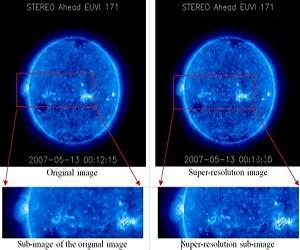
To combat this data overload, scientists from the Visual Computer Centre at Bradford University are developing advanced imaging tools to help scientists visualise what's happening at the Sun, make sense of the data and predict the extreme solar activities that could affect our life here on Earth. Dr Rami Qahwaji will present the tools at the RAS National Astronomy Meeting at Llandudno.

"These techniques are very important," said Qahwaji.

"We are now able to process images on the ground so that the resolution is double that of the source images. Most satellites are limited by the amount of data that they can store and download. The ability to turn medium resolution images into high resolution in the lab means that satellites can take smaller images but more frequently, which will help with real-time monitoring of the Sun and predicting space weather. It also means that scientists can zoom in on the features that interest them, without downloading huge files. There is lot of potential for this technology. For example, it can help overcome small information loss caused by noise and can be used to generate high-definition 3D images."

In addition to enhancing image resolution, the Bradford group has been developing 2- and 3-dimensional visualisation tools to help scientists understand the complex processes that drive solar activity.

By processing multiple of solar images, they have created automated maps that summarise solar activity over an entire solar rotaion and models of magnetic field lines, generating 3-D visualisations of magnetic loop locations on the Sun's rotating globe.

"This is the first time that SDO data has been used to create these synoptic maps and we have also created the first automated 3-D model of magnetic loops," said Qahwaji. "As well as being a useful tool for scientists, we hope that the public will find the 3-D model an interesting way of finding out what's happening on the Sun."

The group is now collaborating with Trinity College Dublin on the development of a new flares predictions system called SMART-ASAP. This computerised system analyses recent images to extract physical properties from solar magnetic features that are analysed further using artificial intelligence techniques to predict whether extreme solar activities will occur.

"Extreme solar activities, such as flares, can affect our life on Earth since we rely more and more on space-based communication and extended power distribution systems, both of which are vulnerable to such activities. The satellite and electrical power industries generate hundreds of billions of dollars in annual revenue and, if we are to protect these assets, we need accurate solar weather forecasting," said Qahwaji.